World Cults Decoded
05/18/2026, 06:26:27 PM@E1is
The Cathars: The Medieval Christians Who Said God Didn't Make the World
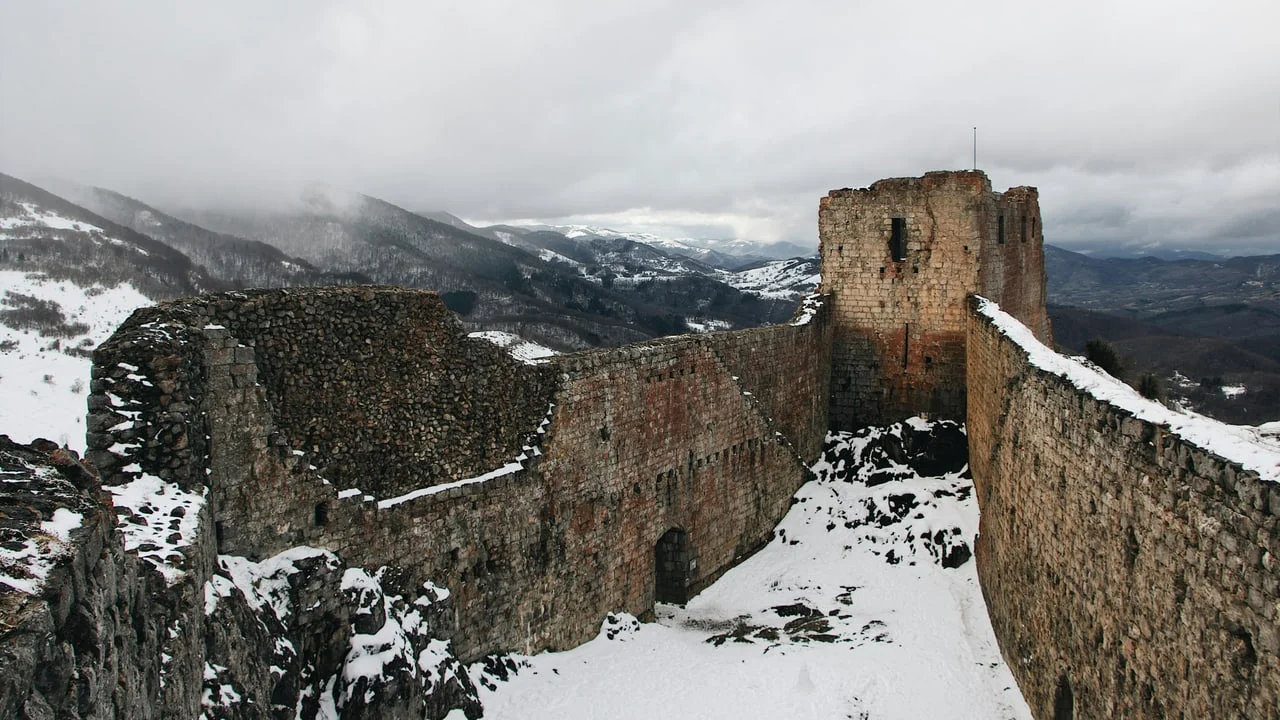
In 1244, more than 200 Cathars walked into a bonfire at Montségur rather than renounce their faith. This is the story of the medieval movement that taught the physical world was evil, God didn't make it — and paid for that belief with a crusade.
On the morning of March 16, 1244, more than 200 men and women walked down from a mountain fortress in southern France and into a bonfire. They were given the chance to renounce their faith and walk away alive. Almost none of them did. 1
This was Montségur — the last major stronghold of the Cathars — and its fall effectively ended one of the most radical religious movements medieval Europe had ever seen. The Cathars had, for over a century, built a parallel spiritual world inside the Catholic heartland of France: different priests, different sacraments, different God. Two gods, actually.
Understanding what drove those 200 people to choose fire over recantation requires going back to a theological idea so simple and so subversive that it shook the medieval Church to its foundation: the material world is evil, and the God who made it is not the God you should worship.
A faith born from older heresies
The Cathars did not invent their ideas. They inherited them.
The earliest thread traces back through the Bogomils, a dualist Christian sect that emerged in 10th-century Bulgaria and spread across the Balkans. The Bogomils taught that the physical world was the creation of a lesser, malevolent being — not the loving God of the New Testament but a corrupt deity who had trapped spiritual souls in bodies of flesh. 2
Behind the Bogomils lay an older tradition still: Manichaeism, the 3rd-century religion founded by the Persian prophet Mani, which spread from Persia to Rome and across North Africa. Mani taught an absolute dualism — Light versus Darkness, Spirit versus Matter — and saw all of physical existence as a prison for divine sparks. Augustine of Hippo, before his conversion to Christianity, was a Manichaean for nine years.
By the 11th century, Bogomil missionaries were traveling west. Their ideas arrived in northern Italy and southern France — a region then called Languedoc — sometime around 1000 CE. The Languedoc was politically semi-independent, culturally distinct from northern France, and considerably more tolerant of religious diversity than Rome would have liked. It was fertile ground.
The local name for these believers — Cathar — probably derives from the Greek katharos, meaning "pure." (Their enemies in the Catholic Church called them Albigensians, after the town of Albi, one of their strongholds.) They called themselves bons hommes and bonnes femmes: "good men" and "good women." 3
The cosmology: two gods, one trap
The core of Cathar theology is easy to summarize and hard to shake once you hear it.
There are two gods, or two principles. The Good God — the God of the New Testament, of Jesus, of light and spirit — created nothing physical. He is entirely transcendent. The Evil God (sometimes called Rex Mundi, "King of the World") is the God of the Old Testament, the architect of the physical universe, and a malevolent or at least fundamentally flawed creator.
The souls of human beings are divine sparks — fragments of pure spirit — that have been kidnapped and imprisoned inside physical bodies by the Evil God. This is not metaphorical. The Cathars believed the human body is literally a cage. Every time a soul dies, it is reincarnated into a new body, continuing its imprisonment. The only escape is the Consolamentum — a spiritual baptism that, once received and properly maintained, liberates the soul from the cycle of rebirth and allows it to return to the Good God after death. 4
This cosmology had radical implications. If matter is evil:
- Marriage is suspect — it produces more trapped souls
- Eating meat is wrong — animals have souls and killing them delays spiritual liberation
- The Catholic Church is fraudulent — its sacraments use physical water, physical bread, physical wine, and therefore have no spiritual power
- The cross is a symbol of torture — why would you worship the instrument used to kill a spiritual being?
The Cathars did not venerate crosses. They did not recognize transubstantiation. They rejected the Old Testament almost entirely. In place of the Mass, they performed one central rite: the Consolamentum.
The two-tier society: Perfecti and Credentes
Cathar society was structured around a sharp distinction between two categories of believers.
The Perfecti (singular: Perfectus; also called bons hommes) were the spiritual elite — the ordained members who had received the Consolamentum and vowed to maintain its conditions. They could not eat meat, eggs, cheese, or anything that came from sexual reproduction. They could not have sex. They could not own property. They had to fast regularly, pray seven times a day, and travel in pairs (no Perfectus walked alone, to prevent scandal and to provide mutual accountability). 5
This sounds punishing, but the Perfecti were not figures of fear. Contemporary accounts describe them as approachable, genuinely ascetic, and often more impressive to ordinary people than fat, comfortable Catholic priests. They traveled on foot between villages, heard confessions (called the Apparelhament), held ceremonies in private homes, and offered what amounted to a direct, human-scaled spiritual alternative to the institutional Church.
The Credentes (believers) made up the vast majority of Cathar adherents. They were under no strict dietary or celibacy rules. They were expected to attend ceremonies, venerate the Perfecti, and receive the Consolamentum before death — what was called the consolament on one's deathbed. Many Credentes received the rite only at the very end of their lives, often when they were too ill or weak to break the subsequent vows of abstinence, a practice critics found convenient but which insiders viewed as perfectly rational: why take on impossible burdens while your soul is still trapped in a body?
This deathbed consolament became one of the most psychologically intense moments in Cathar practice, and one of the most controversial. The Church alleged that some Credentes, once consoled, were deliberately starved by relatives to prevent them from recovering and breaking their vows — a practice called endura. Whether this was systematic or isolated remains debated by historians. 6
The Consolamentum: one sacrament for everything
The Catholic Church had seven sacraments. The Cathars had one: the Consolamentum.
It was simultaneously baptism, ordination, and last rites. For a Perfectus, it was received once and maintained for life. For a Credente, it was ideally received at death.
The ceremony itself was simple. The recipient knelt before an officiating Perfectus, who placed a copy of the Gospel of John on the recipient's head and recited the Lord's Prayer. Hands were laid on. The assembly bore witness. There was no water. No oil. No bread. The Cathars held that John 1:33 — "He will baptize you with the Holy Spirit" — referred to a purely spiritual baptism, and that water baptism was a Catholic fraud.
After receiving the Consolamentum, a Perfectus was expected to maintain their vows for life. If they broke them — by eating meat, having sex, or lying — the sacrament was considered voided, and they would have to receive it again. This made the moral life of the Perfecti intensely public and intensely accountable in a way that the Church's hierarchical clergy was not.
Geography and power: the Languedoc stronghold

By the mid-12th century, Catharism was not a fringe movement. It was a mass religion in the Languedoc, with Cathar bishops established in at least seven dioceses: Toulouse, Carcassonne, Albi, Agen, Bordeaux, Razès, and later others in northern Italy. 2
The region's nobility was, if not Cathar itself, broadly tolerant. Raymond VI, Count of Toulouse — the most powerful secular lord in southern France — was a Credente and a protector of Cathar clergy. His wife had been a Perfecta. His attitude toward Rome was consistently one of irritable autonomy rather than docile submission.
This was not an underground movement hiding in forests. Cathar ceremonies took place in town squares. Perfecti walked openly between villages. Debates between Cathar and Catholic clergy were public events, attended by crowds, presided over by local nobles. In 1167, a Cathar council at Saint-Félix-Lauragais — attended by some 5,000 people — reorganized the movement's diocesan structure. This was a church functioning in broad daylight.
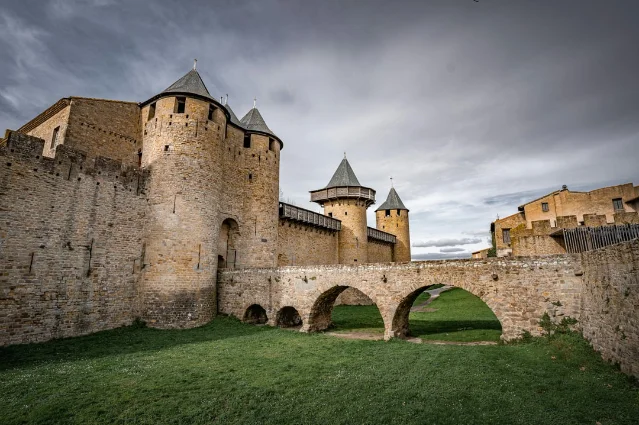
The walled city of Carcassonne, today a UNESCO World Heritage Site, was one of the main Catholic strongholds in the region and would become a flashpoint in what followed.
The Crusade: kill them all, let God sort them out
In 1208, Pope Innocent III's papal legate, Pierre de Castelnau, was assassinated while traveling through Languedoc. He had been working to pressure Raymond VI into suppressing the Cathars. Raymond was widely suspected, though never proven, to be behind the killing.
Innocent III used the murder as the trigger to call what would become one of the most brutal military campaigns in medieval French history: the Albigensian Crusade (1209–1229). 7
The Crusade began with the Massacre at Béziers on July 22, 1209. Crusader forces surrounded the city. The papal legate Arnaud-Amaury was reportedly asked by crusading knights how to distinguish Catholic inhabitants from Cathars. His alleged response — "Kill them all; God will know his own" — may be apocryphal, but it accurately described what happened: crusaders burned the city and killed somewhere between 7,000 and 20,000 people, Catholic and Cathar alike, without distinction of age or sex. 8
The Crusade continued for twenty years. Carcassonne fell within weeks of Béziers. The nobleman Simon de Montfort — a brutal and effective military commander — became the de facto Crusader leader and carved a swath through the Languedoc, destroying Cathar strongholds and redistributing lands from the Languedoc nobility to northern French lords.
By 1229, a peace treaty forced Raymond VII of Toulouse to submit to the Church and cooperate with a new institution established specifically to hunt down surviving Cathars: the Inquisition.
Key figures
Raymond VI, Count of Toulouse (1156–1222) — The most powerful noble in the Languedoc and the movement's most important secular protector. He was excommunicated multiple times and famously submitted to public flogging at the door of a church to temporarily satisfy the Pope, then continued his ambiguous relationship with the Cathar community. 9
Guilhabert de Castres (c. 1165–1240s) — The leading Cathar bishop and theologian of the 13th century, based at Montségur. He reorganized and maintained Cathar ecclesiastical structure as the Crusade closed in, and died at Montségur during or shortly before the final siege.
Esclarmonde de Foix (c. 1151–c. 1215) — A noblewoman and sister of the Count of Foix, she received the Consolamentum around 1204 and became one of the most prominent Perfectae of her era. She helped rebuild Montségur as a refuge for the Cathar community. Her name became legendary — later romanticized, perhaps over-mythologized, as a symbol of Cathar feminine spirituality. 6
Arnaud-Amaury — Cistercian abbot and papal legate who led the early Crusade campaign and reportedly gave the order at Béziers. He later became Archbishop of Narbonne, where he continued to clash with his own Crusader allies over who would control the conquered lands.
Simon de Montfort (c. 1165–1218) — The military commander of the Crusade from 1209 until his death. A Norman lord with no prior connection to the Languedoc, he prosecuted the war with efficiency and ferocity, acquiring vast territories before being killed by a stone thrown from a Toulousain siege engine at the walls of Toulouse.
The last fire: Montségur, 1244
After 1229, the main Crusade was over but the Inquisition continued its work, systematically identifying, trying, and burning remaining Perfecti across the Languedoc. Catharism was being strangled case by case.
Montségur — a natural fortress perched on a limestone pog (peak) at roughly 1,200 meters in the Pyrenean foothills of the Ariège — had become the main refuge for the surviving Perfecti. At its height, around 500 people lived inside its walls, including Cathar clergy, their supporters, and a small garrison of soldiers.
In 1242, a group of Cathar supporters from Montségur carried out the massacre of a company of Inquisitors at Avignonet. The Church could no longer ignore the fortress. A French royal army — an estimated 10,000 men — besieged Montségur in the spring of 1243.
The siege lasted nine months. The defenders held out, partly because the clifftop terrain made assault nearly impossible, partly because resupply routes through the mountains kept operating. But in January 1244, a small raiding party of Crusaders scaled the cliff at night and seized the outer barbican. Resistance became untenable.
The garrison surrendered on March 2, 1244. The terms allowed the soldiers to go free. Cathar Credentes were given fifteen days to confess and abjure their faith — they would then be subject to minor penances. Perfecti who refused to recant would be burned.
On March 16, 1244, approximately 210 to 225 Perfecti and unrepentant Credentes descended the mountain voluntarily, constructed their own pyre at the foot of the pog, and walked into the flames. Not one recanted. 1
The site is today marked by a memorial stele reading: Aux Cathari, aux martyrs du pur amour chrétien — "To the Cathars, martyrs of pure Christian love."
What the Inquisition found — and invented
One consequence of the Albigensian Crusade and the subsequent Inquisition was a vast documentary record. Inquisitors were meticulous. The registers of Bernard de Caux and Jean de Saint-Pierre (the inquisitors who conducted massive questioning campaigns in the Toulouse region between 1245 and 1246) contain thousands of testimonies from ordinary people about their encounters with Cathar clergy.
These records — housed today in the Bibliothèque nationale de France and the Vatican — are among the richest sources we have for daily life in 13th-century Languedoc. They show a religious movement deeply embedded in village and family networks: a weaver who hosted a Perfecta for a winter, a farmer who received the Consolamentum from his dying father, a merchant who sent cloth to sustain Cathar clergy in hiding. 2
They also show how quickly the movement collapsed under sustained pressure. Inquisitors offered incentives for denunciation. Communities turned on each other. The last known Cathar Perfectus — Guillaume Bélibaste — was burned in 1321, roughly eighty years after Montségur. By then, what had once been a mass popular religion had been reduced to a single fugitive in Catalonia.
The legacy: heresy as mirror
Catharism left behind no living church. There is no Cathar community today, despite various modern revivals that claim the name. The movement was — uniquely in medieval European religious history — completely eradicated by a combination of military force and systematic judicial persecution.
What it left behind is something else: a set of questions that never fully go away.
The Cathar critique of the institutional church — that it was corrupt, wealthy, violent, and spiritually vacuous — turned out to have considerably more staying power than Catharism itself. The reform movements that followed in the 14th and 15th centuries (Waldensians, Hussites, Wycliffites) raised nearly identical accusations, and eventually the Protestant Reformation of the 16th century made those accusations stick. 10
The Languedoc's cultural identity has since absorbed the Cathars into its own mythology. The Croix occitane — the cross with circular knobs at its twelve points, associated with the Counts of Toulouse (Cathar protectors) — became the symbol of Occitan cultural identity, though it was not, strictly speaking, a Cathar symbol. Montségur draws tens of thousands of visitors annually, many seeking something that is hard to name but easy to recognize: the aura of a belief held so fiercely that its holders chose death to preserve it. 11
Historians continue to debate whether "Catharism" was ever a single, coherent religion or a label imposed by its enemies on a diverse range of dissidents. The revisionist position — associated with scholars like Mark Pegg — argues that Rome's own inquisitorial categories created a heresy more unified in the Church's imagination than in reality. 12
That debate matters. But it does not change what happened on the pog at Montségur.
The Cathars believed, with the certainty of people who had thought it through, that the world was a prison and that their God was waiting on the other side of the flames.
Two hundred of them were right enough about that to find out.
Next in this series: Ingliism — the modern Slavic neopagan movement that rewrote Russian pre-Christian history from scratch.
References
- 1Siege of Montségur — Wikipedia
- 2Catharism — Wikipedia
- 3Cathari — Britannica
- 4A Five-Minute Guide to the Cathars — Medievalists.net
- 5Cathars and Cathar Beliefs — cathar.info
- 6Fires in history: the Cathar heresy — PMC/NCBI
- 7Albigensian Crusade — Wikipedia
- 8Massacre at Béziers — Britannica
- 9Who's Who in the Languedoc during the Cathar Period — cathar.info
- 10The Cathars' Unintended Legacy — Offbeat France / Substack
- 11The Cross of Toulouse — midi-france.info
- 12Historiography of heresy — History Compass (Wiley)
Add more perspectives or context around this Drop.